Finance
Fleet Truck Insurance: What Small Trucking Companies Actually Pay and How to Stop Overpaying Before Your Second Truck


The moment I started thinking about adding a second truck to my operation, my broker said something that stopped me cold.
“Stella, the day you go from one truck to two, you are no longer just an owner-operator. You are a fleet. And fleet truck insurance is a completely different conversation.”
I had spent three years learning how to manage insurance on a single truck out of Columbus, Ohio. I thought I understood commercial trucking coverage. What I did not realize was that scaling from one unit to two — and eventually to three or four — introduces an entirely new set of insurance dynamics, pricing structures, and coverage requirements that most small operators walk into completely unprepared.
This article is what I learned before, during, and after that transition. If you are running one truck and thinking about growing, or if you are already managing a small fleet and feel like your premiums are out of control, this is the guide I wish I had found two years ago.
What Is Fleet Truck Insurance
Fleet truck insurance is a commercial auto policy designed to cover multiple vehicles under a single policy rather than insuring each truck on a separate individual policy.
The technical definition of a “fleet” varies by insurer. Some carriers define fleet as two or more vehicles. Others set the threshold at five. For practical purposes, most independent trucking operators with two to ten trucks are shopping in what the industry calls the small fleet market — a segment with its own pricing dynamics, underwriting requirements, and coverage structures.
The core advantage of fleet truck insurance over individual per-truck policies is consolidation. One policy. One renewal date. One broker relationship. One premium payment. For an operator managing multiple trucks, drivers, and routes simultaneously, that administrative simplicity has real value beyond just the premium cost.
The core challenge is that fleet policies also consolidate risk. One serious accident involving any truck in your fleet affects the pricing of your entire policy at renewal — not just the coverage on the truck involved. That reality changes how you think about driver selection, safety programs, and claims management in ways that single-truck operators never have to consider.
Fleet Truck Insurance Cost — Real Numbers for Small Operators
Fleet truck insurance premiums vary significantly based on fleet size, driver profiles, freight type, and operating territory. Here are realistic 2025 market ranges for small fleet operators:
| Fleet Size | Annual Premium Range | Per Truck Average | Notes |
|---|---|---|---|
| 2 Trucks | $22,000 — $38,000 | $11,000 — $19,000 | Minimal fleet discount, still priced close to individual rates |
| 3 — 5 Trucks | $35,000 — $75,000 | $9,000 — $16,000 | Fleet discounts begin to appear meaningfully |
| 6 — 10 Trucks | $65,000 — $130,000 | $8,000 — $14,000 | Stronger fleet pricing, safety programs start mattering significantly |
| 11 — 20 Trucks | $110,000 — $220,000 | $7,500 — $12,000 | Loss history becomes dominant pricing factor |
When I got my first fleet quote for two trucks, my per-truck cost was actually slightly higher than what I had been paying as a single-unit operator. My broker explained that this is common at the two-truck level — the fleet discount does not fully kick in until you have three or more units, and the addition of a second driver profile added risk to the overall policy.
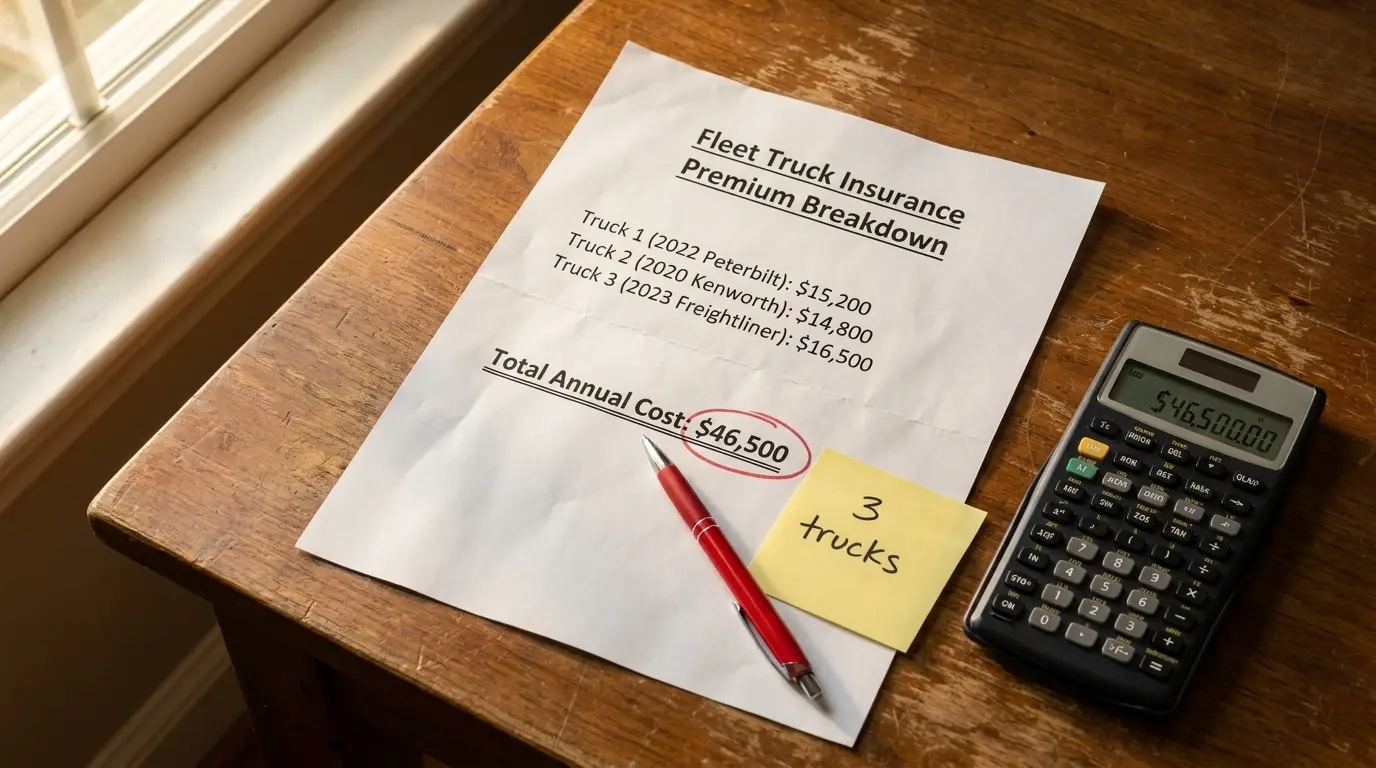
By year two with three trucks, my per-truck average had dropped by approximately $1,800 compared to what two individual policies would have cost me. The math starts working in your favor as the fleet grows — but only if you manage your driver pool and loss history carefully.
What Fleet Truck Insurance Actually Covers
A properly structured fleet truck insurance policy covers the same fundamental categories as a single-truck policy, applied across all vehicles in the fleet. Here is the full coverage breakdown:
| Coverage | What It Covers | Fleet Consideration |
|---|---|---|
| Primary Auto Liability | Third-party injuries and property damage | Applies per occurrence across all fleet vehicles — single limit covers any truck in the fleet |
| Physical Damage | Collision, theft, fire, weather on your trucks | Each truck scheduled separately with its own stated value |
| Motor Truck Cargo | Freight being hauled by any fleet vehicle | Single cargo limit applies — make sure limit covers your highest value load across all trucks simultaneously |
| General Liability | Non-driving incidents across all operations | Especially important as fleet size and operational complexity grows |
| Non-Trucking Liability | Personal use of trucks not under dispatch | Applies to each truck — critical for any leased drivers using trucks off-dispatch |
| Trailer Interchange | Trailers operated under interchange agreements | More relevant as fleet grows and trailer sharing increases |
One cargo coverage mistake I almost made: my single-truck cargo limit was $100,000 per load. When I moved to a three-truck fleet policy, I initially kept the same $100,000 limit without thinking through what it meant when all three trucks were loaded simultaneously. If two trucks were involved in separate incidents on the same day, that single limit could be exhausted covering just one of them. I increased my cargo limit and paid an additional $600 annually. That was the right call.
How Fleet Truck Insurance Underwriting Works
Fleet underwriting is more complex than single-truck underwriting because the insurer is evaluating not just one driver and one vehicle but an entire operation. Understanding what underwriters look at helps you present your fleet in the strongest possible light.

Driver Pool Quality
This is the dominant factor in fleet insurance pricing. Every driver operating a truck in your fleet is evaluated individually — their CDL experience, Motor Vehicle Record, claims history, and age all contribute to a composite driver risk score that anchors your premium calculation.
One high-risk driver in a five-truck fleet can increase the entire fleet premium significantly. I learned this directly when I hired a driver in my second year who had a speeding violation and one minor at-fault accident from three years prior.
My broker told me upfront that adding that driver profile would increase my renewal premium by approximately $2,200 across the fleet. That was information I needed before I made a hiring decision, not after.
Fleet Safety Program
Carriers price fleet policies more favorably when the operator has documented safety practices in place. This includes written driver qualification files, regular vehicle inspection records, a drug and alcohol testing program, and documented driver training. These are not just regulatory requirements — they are premium reduction tools when presented to underwriters at renewal.
Loss Run History
When you apply for fleet truck insurance, carriers will request your loss runs — a formal claims history report from your current or prior insurer covering the past three to five years. A clean loss run is one of the most valuable assets a fleet operator can bring to a renewal negotiation.
A loss run showing multiple claims, particularly at-fault liability claims, is the fastest way to a significant premium increase or a non-renewal notice.
Equipment Age and Safety Technology
Fleets running newer trucks equipped with collision mitigation systems, electronic stability control, and forward-facing cameras qualify for safety technology discounts that are more meaningful at the fleet level than the single-truck level.
When I replaced my oldest truck with a newer unit in year three, my fleet premium dropped by more than the discount on just that one truck — the overall fleet safety profile improved and the underwriter priced the whole book of business more favorably.
Individual Policies vs Fleet Policy — When to Make the Switch
This is a question I get asked regularly in trucking communities, and the honest answer is that it depends on your specific situation.
- At two trucks: Fleet savings are minimal. Individual policies may actually be more flexible and competitive depending on your driver profiles. Get quotes both ways before deciding.
- At three trucks: Fleet pricing starts becoming meaningfully advantageous for most operators. Administrative consolidation adds value at this point as well.
- At four or more trucks: A fleet policy almost always makes more financial and operational sense than managing four separate individual policies with different renewal dates and different brokers.
- Mixed driver risk profiles: If you have one high-risk driver and three low-risk drivers, a fleet policy may price the entire pool at the higher risk level. Individual policies for your low-risk drivers might actually be cheaper in this scenario.
My broker ran both comparisons when I hit three trucks. The fleet policy was $3,400 cheaper annually than three individual policies would have been for the same coverage. At four trucks the following year, the gap grew to approximately $5,800. The math works — but only when your driver pool is solid.
How to Reduce Your Fleet Truck Insurance Premium
Fleet premiums are large numbers. The levers that reduce them are worth understanding in detail because even a 10 percent reduction on a $60,000 annual premium is $6,000 back in your operating budget.
- Build and maintain a formal driver qualification file for every driver. FMCSA-compliant DQ files demonstrate professional fleet management to underwriters and support favorable pricing at renewal.
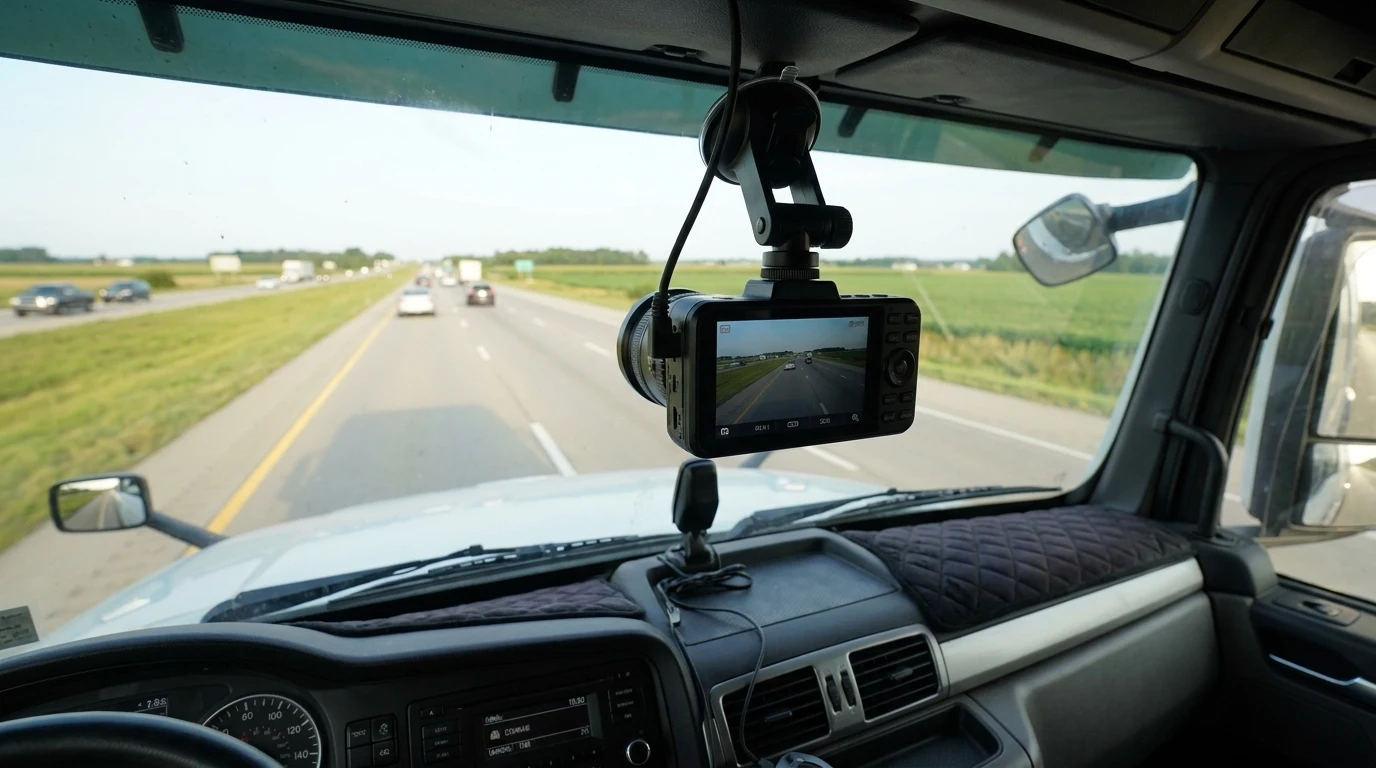
- Install dashcams on every truck in the fleet. Forward-facing dashcams reduce fraudulent claims and provide documentation in disputed liability situations. Several carriers offer documented discounts for fleets with dashcam programs. Dual-facing cameras that also monitor driver behavior — distraction, fatigue signs — carry even larger discounts with some carriers.
- Implement a formal drug and alcohol testing program. FMCSA-mandated testing is a legal requirement, but documenting your program formally and presenting it to underwriters positions your fleet as a professionally managed operation.
- Re-shop your fleet coverage at every renewal. Fleet premiums are large enough that the savings from competitive shopping are substantial. My broker shops my fleet coverage across a minimum of eight carriers at every renewal cycle.
- Manage claims carefully. Not every minor incident warrants a formal claim. Small physical damage repairs below your deductible should be paid out of pocket rather than reported — keeping your loss run clean has long-term premium value that far exceeds short-term repair cost savings.
- Pay annually. Monthly installment financing on a $60,000 fleet premium at 12 percent adds $7,200 in financing fees annually. Paying upfront eliminates that cost entirely.
Mistakes Small Fleet Operators Make With Insurance
Three years of managing a growing fleet in Columbus, Ohio has shown me the same mistakes repeated by operators who are smart about trucking but not yet experienced with fleet insurance management.
- Hiring drivers without running MVRs first. One undisclosed violation on a new driver’s record can trigger a mid-term premium endorsement that raises your entire fleet rate. Always pull MVRs before a driver touches your equipment.
- Not updating the vehicle schedule when adding trucks. Adding a truck to your fleet without notifying your insurer immediately creates a coverage gap. Any incident involving an unscheduled vehicle during that gap may be denied.
- Carrying the same cargo limit from a single-truck policy. As noted earlier, a cargo limit appropriate for one truck may be dangerously insufficient when multiple trucks are hauling simultaneously.
- Accepting auto-renewal without shopping. Insurers count on renewal inertia. Fleet premiums are large enough that competitive shopping at every renewal is not optional — it is a financial responsibility to your business.
- Not reading loss run reports before applying for new coverage. Request your own loss runs annually. Errors in claims history — incorrectly attributed incidents, closed claims still showing as open — are more common than most operators realize and can be corrected before they affect your next quote.
Questions to Ask Your Fleet Insurance Broker
The right broker is the most important relationship in your fleet insurance management. Before placing your fleet coverage, get clear answers to these questions:
- How many carriers did you submit our fleet to, and which ones declined and why?
- What is the financial strength rating of the recommended carrier with A.M. Best?
- How does adding a driver with a prior violation affect our fleet premium?
- What safety program documentation would improve our renewal pricing?
- What specific exclusions in this policy should we be aware of given our freight type and operating territory?
- How is a single at-fault claim by one driver priced into our overall fleet renewal?
The Bottom Line on Fleet Truck Insurance
Fleet truck insurance is one of the largest fixed costs in a small trucking operation. For a three-truck fleet, you are looking at $35,000 to $75,000 annually before you factor in fuel, truck payments, maintenance, or driver wages.
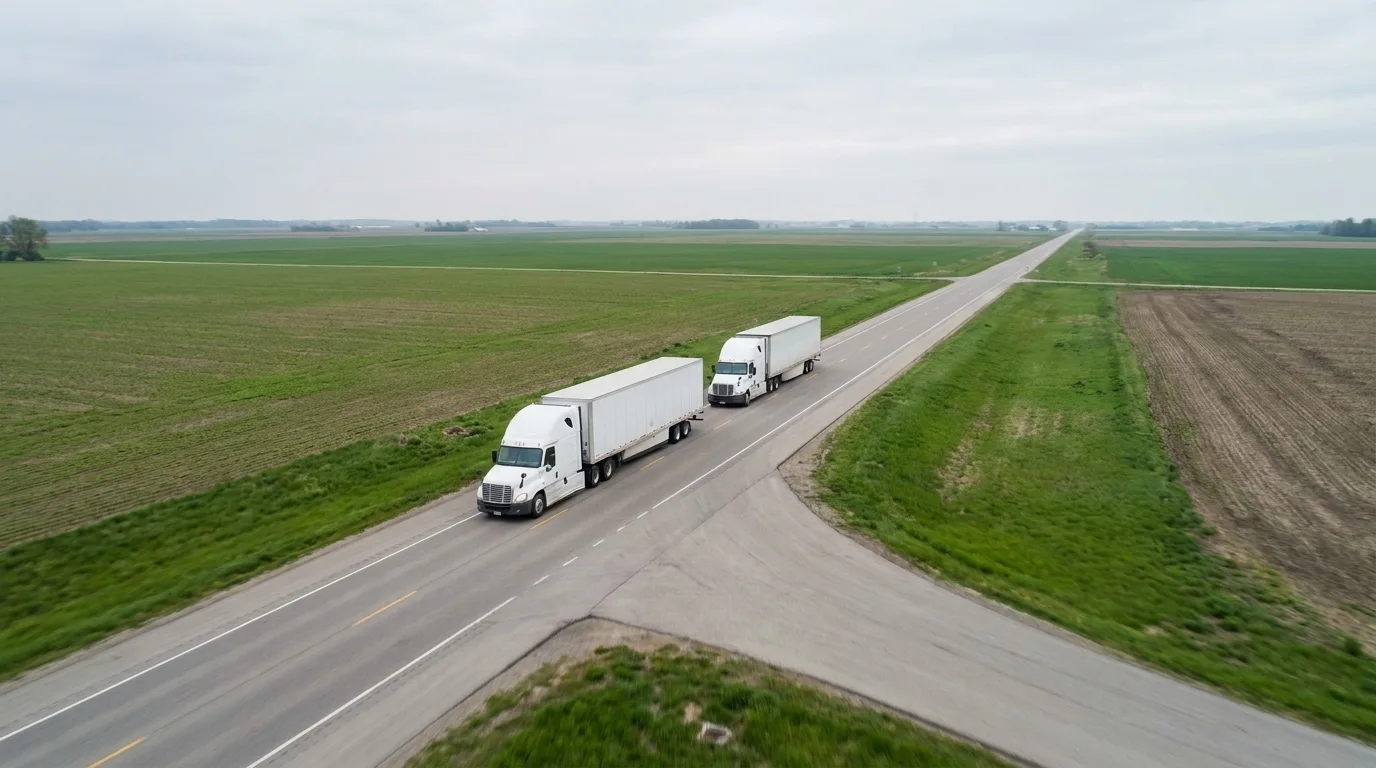
That number is real. It is also manageable — but only for operators who treat insurance as an active business management responsibility rather than a bill that arrives at renewal and gets paid without question.
The drivers and fleet owners who control their premiums are the ones who build clean driver pools, document their safety programs, shop their coverage aggressively at every renewal, and understand every line of their policy before they sign it.
I started with one truck in Columbus, Ohio, terrified by a $21,600 insurance quote. Three years later I am managing a small fleet, my per-truck insurance cost has decreased every single year, and I understand exactly why every dollar of my premium is what it is.
That knowledge did not come from luck. It came from asking every question, reading every document, and never accepting a number I did not fully understand.
Stella Brown is an independent owner-operator and small fleet manager based in Columbus, Ohio. She hauls dry freight across the Midwest and Southeast and writes about the real business side of trucking — insurance, fleet management, financing, and the financial realities of growing a small trucking operation. She re-shops her fleet coverage every single renewal and has never regretted the time it takes.
ENJOY TRUCKING WITH ME?


Hotshot Trucking Insurance: What It Really Costs, What You Actually Need, and How I Help Fellow Operators Stop Paying Too Much

Commercial Auto Insurance Quotes: How I Stopped Guessing and Started Comparing — A Complete Guide for Owner-Operators in 2026

Bobtail Insurance: What It Costs, What It Covers, and Why Skipping It Was Almost the Biggest Mistake of My Trucking Career

Will AI Replace Truck Drivers? Here Is What the Data Actually Says in 2026
