Trucking Business
Semi Truck Insurance Cost in 2026: What I Actually Paid as a First-Year Owner-Operator and How I Brought It Down


The first time I asked about semi truck insurance cost, the broker on the phone quoted me $23,400 annually. I remember the exact number because I wrote it down, stared at it for a full minute, and then quietly questioned every decision I had made in the previous six months.
I had just purchased my first truck. A 2019 Freightliner Cascadia, financed over five years, sitting in my driveway in Knoxville, Tennessee. I had a signed lease agreement with a regional carrier, a brand new Class A CDL, and absolutely no idea that insurance was going to hit that hard before I had earned a single dollar behind the wheel.
That quote, by the way, was not even the highest one I received. Another broker came back at $27,800. A third landed at $19,100. Same truck. Same driver. Same routes. Three wildly different numbers, none of which I fully understood at the time.
Over the following three years, I learned more about semi truck insurance cost than I ever wanted to know. I changed brokers, restructured my coverage, added endorsements, and watched my premium move in both directions depending on decisions I made on and off the road. This article is everything I put together — the real numbers, the real factors, and the real strategies that actually worked for me.
What Does Semi Truck Insurance Actually Cost in 2026
The honest answer is that semi truck insurance cost varies so widely that a single number is almost meaningless without context. That said, here are the realistic ranges based on the most common driver and operation types in the current market:
| Driver / Operation Type | Annual Premium Range | Monthly Estimate |
|---|---|---|
| New CDL holder, leased to carrier | $12,000 — $16,000 | $1,000 — $1,333 |
| New CDL holder, own authority | $16,000 — $28,000 | $1,333 — $2,333 |
| Experienced driver (3+ years), own authority | $9,000 — $15,000 | $750 — $1,250 |
| Owner-operator, hazmat endorsement | $14,000 — $22,000 | $1,166 — $1,833 |
| Small fleet (2-5 trucks) | $20,000 — $50,000+ | $1,666 — $4,166+ |
My first-year premium running under my own authority came in at $18,400 after I shopped three brokers and negotiated on a few coverage details. By year three, that same coverage package — with better limits and an added endorsement — cost me $13,200. The difference was experience, a clean record, and knowing exactly what questions to ask.
What Is Actually Included in That Number
This is where most first-time buyers get confused. Semi truck insurance is not a single policy with a single price. It is a bundle of individual coverages, each priced separately, that together form your total annual premium. Understanding what you are paying for is the first step toward managing the cost intelligently.
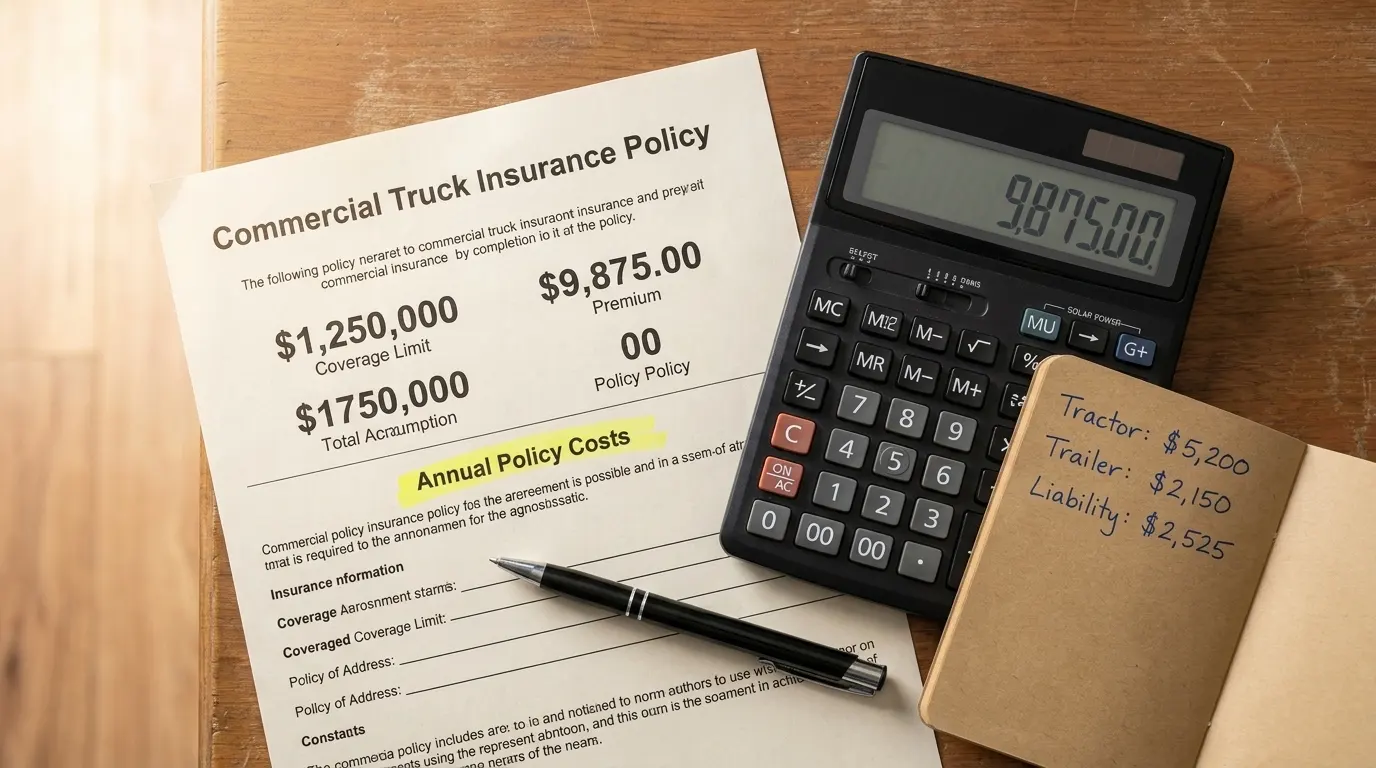
Here is how a typical owner-operator insurance package breaks down:
| Coverage | What It Covers | Typical Annual Cost |
|---|---|---|
| Primary Liability | Injuries and property damage to others when you are at fault | $8,000 — $14,000 |
| Physical Damage | Damage to your own truck from collision, theft, weather | $2,500 — $5,000 |
| Motor Truck Cargo | The freight you are hauling if damaged or lost | $1,200 — $2,500 |
| Bobtail Insurance | Your truck when driving without a trailer | $400 — $900 |
| General Liability | Non-driving incidents — loading, unloading, premises | $500 — $1,200 |
| Uninsured Motorist | Protection if you are hit by an uninsured driver | $300 — $700 |
In my first year, primary liability alone was $10,800 of my total $18,400 premium. That one line item — the federally required minimum coverage — represented nearly 59 percent of my entire insurance spend. Everything else was built around it.
The 7 Factors That Determine Your Semi Truck Insurance Cost
When I finally sat down with an independent broker who took the time to actually explain my quotes rather than just hand me numbers, the pricing stopped feeling random. Every dollar in your premium traces back to specific risk factors that insurers calculate with significant precision. Here are the seven that matter most:
1. Your CDL Experience Level
This is the single largest pricing factor for most owner-operators, and the one that improves automatically over time as long as you keep a clean record. Drivers with less than two years of CDL experience are considered high-risk by virtually every commercial insurer.
The premium penalty for being a new driver can range from 40 to 80 percent above what an experienced driver pays for identical coverage. My broker estimated that my first-year premium would drop by approximately $4,000 once I had three clean years on my record. He was almost exactly right.
2. Your Motor Vehicle Record
Insurers pull your MVR — your complete driving history — and price your policy based on what they find. A single serious violation such as reckless driving, DUI, or excessive speeding can add thousands to your annual premium and may disqualify you from coverage with certain carriers entirely.

Multiple violations within a three-year window are even more damaging. My record was completely clean when I applied, and my broker told me it was the strongest thing working in my favor given my limited experience.
3. The Type of Freight You Haul
Not all cargo is priced equally. General dry freight — the bread and butter of most long-haul operations — carries the lowest cargo insurance rates. As you move into specialty freight categories, rates increase significantly:
- Dry van general freight: Lowest cargo rates, most widely insurable
- Refrigerated freight: Higher rates due to temperature sensitivity and spoilage risk
- Electronics and high-value goods: Significantly higher rates, some carriers won’t touch it
- Hazardous materials: Highest cargo rates plus mandatory hazmat endorsement and additional liability requirements
- Oversized or overweight loads: Specialty coverage required, premium pricing
I started on dry van general freight specifically because my broker advised it from an insurance cost perspective. It was the right call for year one.
4. Your Operating Radius
Local operators — those running within a defined radius of their home base — generally pay less than regional and long-haul drivers. More miles driven means more exposure, and insurers price for that exposure directly. Long-haul operations crossing multiple state lines carry the highest radius-based pricing.
5. The Value and Age of Your Truck
Physical damage coverage is priced as a percentage of your truck’s stated value. A newer, more expensive truck costs more to insure for physical damage simply because the replacement cost is higher.
However, newer trucks also tend to have better safety ratings and modern collision avoidance technology, which can offset some of that increase on the liability side. My 2019 Cascadia hit a reasonable middle ground — recent enough to have strong safety features, old enough that the physical damage premium was not extreme.
6. Your Deductible Choices
Choosing a higher deductible on your physical damage coverage directly lowers your premium. This is one of the few pricing levers you actually control at the time of purchase. In my first year, I chose a $2,500 deductible on physical damage.
Some drivers choose $5,000 or even $10,000 deductibles to bring premiums down, but that strategy only works if you have the cash reserves to cover that deductible in an emergency. Do not choose a deductible you cannot actually pay.
7. Your Garaging Location
Where your truck is physically garaged when not in use affects your premium. High-crime zip codes carry higher comprehensive coverage rates. States with higher litigation rates and larger jury verdicts tend to have higher liability premiums across the board. This is one factor that surprises most new owner-operators — your home address is part of your insurance pricing profile.
How I Brought My Premium Down Over Three Years
I want to be specific here because general advice like “maintain a clean record” is not particularly useful when you are staring at a $18,000 annual bill in year one. Here is exactly what I did and what it cost or saved me:
- Switched to an independent broker in year two: My first broker worked primarily with one carrier. An independent broker shopped my renewal across seven carriers and found a primary liability carrier that came in $1,400 lower for the same limits. Savings: $1,400 annually.
- Installed a dual-facing dashcam: My broker confirmed at my second renewal that documented safety equipment contributed to a slightly improved risk profile. Estimated savings: $300 — $500 annually.
- Switched to annual payment: Monthly payment plans carry financing fees of 10 to 15 percent. Paying my full premium annually eliminated those fees. Savings: approximately $1,800 in year two.
- Three clean years on my MVR: The experience discount that my broker had projected materialized almost exactly as he predicted. Savings at year three renewal: approximately $3,200 compared to my year one rate.
- Raised my physical damage deductible from $2,500 to $5,000: By year three I had sufficient cash reserves to carry the higher deductible comfortably. Savings: $680 annually.
Total reduction from year one to year three: approximately $7,580 annually on a coverage package that was actually slightly broader than what I started with. The savings were real and they were earned systematically, not by luck.
Mistakes That Will Increase Your Semi Truck Insurance Cost
I made some of these. Others I watched fellow drivers make in trucking communities I am part of. Every one of them is avoidable with the right information upfront.
- Going directly to a single carrier without comparing quotes. The spread between carriers for identical coverage can be $3,000 to $8,000 annually. Always shop with an independent broker.
- Choosing the lowest premium without reading the exclusions. Cheap policies are often cheap because they are full of exclusions that leave you exposed when you actually need coverage.
- Letting your policy lapse even for a single day. A lapse in commercial coverage is a major red flag on your insurance history and can result in significantly higher rates at your next application.
- Not reporting a change in operations to your insurer. If you switch freight types, change your operating radius, or add a trailer you own, your coverage needs to reflect that. Operating outside your policy’s described operations can result in a denied claim.
- Skipping non-trucking or bobtail coverage to save money. The gap between a carrier’s liability coverage and your own personal coverage when you are off-dispatch is real. Filling it costs a few hundred dollars a year. Not filling it can cost everything.
What to Ask Your Broker Before You Sign Anything
The right broker makes an enormous difference in both the price you pay and the quality of coverage you end up with. Before signing any commercial truck insurance policy, ask these questions directly:
- What carriers did you quote this with, and why did you recommend this one?
- What is the claims process if I have an accident on a weekend or holiday?
- What specific exclusions does this policy carry that I should be aware of?
- How will a single at-fault claim affect my renewal premium?
- What is the financial strength rating of this carrier with A.M. Best?
- What discounts am I currently not receiving that I might qualify for?
A broker who cannot answer these questions clearly and completely is not the right broker for your business.
The Bottom Line on Semi Truck Insurance Cost
Semi truck insurance is expensive. There is no version of this conversation where I tell you otherwise and remain honest with you. For a new owner-operator running under their own authority in 2025, budgeting $15,000 to $22,000 for your first year of coverage is realistic depending on your location, experience, and freight type.
What I can tell you is that the cost is manageable, it decreases meaningfully as your experience grows and your record stays clean, and the strategies that bring it down are available to any driver willing to put in the work to understand their own policy.
I sat at that kitchen table three years ago genuinely wondering if I had made a mistake. Today that question does not cross my mind. The insurance is a line item in a business that works — one I built from a single truck, a fresh CDL, and a lot of nights doing exactly this kind of research.
Know what you are buying. Know why it costs what it costs. And never stop asking questions until the numbers make sense to you.
Stella Brown is an independent owner-operator based in Columbus, Ohio, hauling dry freight across the Southeast and Mid-Atlantic. She writes about the business side of trucking — insurance, financing, and the financial realities of running a one-truck operation. She has been driving under her own authority for three years and considers her broker one of the most important relationships in her business.
ENJOY TRUCKING WITH ME?


Hotshot Trucking Insurance: What It Really Costs, What You Actually Need, and How I Help Fellow Operators Stop Paying Too Much

Commercial Auto Insurance Quotes: How I Stopped Guessing and Started Comparing — A Complete Guide for Owner-Operators in 2026

Bobtail Insurance: What It Costs, What It Covers, and Why Skipping It Was Almost the Biggest Mistake of My Trucking Career

Will AI Replace Truck Drivers? Here Is What the Data Actually Says in 2026
